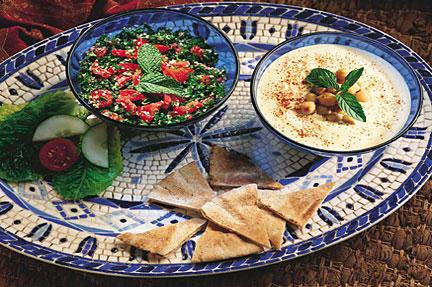
Continuity and Adaptation in Arab American Foodways by Lockwood & Lockwood (2000)
Summary and Reflection: This article details the presence, nature, and evolutionary identity of Arab food brought by Arab immigrants to urban Detroit. While the authors, Lockwood and Lockwood (2000), begin their work with a comparison on becoming ethnic a parallel to becoming a new subculture (p. 515), their main focus becomes about the diffusion of Arab food and foodways (how food is associated, used, presented, prepared, shared, taught, etc.) in Detroit in the Arab diaspora.
One of the strongest points made early on is that in any immigration story, one cannot make blanket generalizations about a sending country's population based on the receiving country's immigrant intake. For example, immigrants are always being drawn more heavily from certain regions within a country, from certain socio-economic conditions, religious groups, etc. (p. 515). Clearly, this can be better understood when considering our own nation—as diverse as we are from the Midwest to the South, the East Coast and West Coast, not to mention the diversity even within those regions. So it is when immigrants arrive here now, whether they are low-income Mexican laborers, persecuted Hmong, or asylum-seeking Somalis.
Such immigrant "pre-screening" has repercussions on the receiving country's perceptions of the immigrant group and their country of origin as well. Speaking specifically to food, as this article does, I can't help but think of Italian cuisine...that is, Italian cuisine as it is popularly understood in the U.S. (and again, more specifically, within my socio-economic bracket and in a Midwestern state). Naturally, the most common elements of Italian cuisine for me are spaghetti with tomato and meat sauce, pizza, lasagna, chicken parmesan, etc. Heavy on the melty white cheese, rich tomato sauch, meatballs and pasta. Of course, once I actually went to Italy and traveled to the various regions of that very diverse (albeit small) country, I was amazed as my Italian food paradigm was smashed to smithereens---and I mean that in a good way. Italian food—the "real" kind—is as delicious as it is diverse. And even though I found places that were purportedly "authentic", none of the versions of pizza, spaghetti bolognese (the tomato meat sauce we know), or lasagna that I sampled tasted like "home". Whether in flavor, texture, serving style, or ingredients, the details had invariably changed even in these Italian American standards.
The Lockwood & Lockwood focuses on these phenomena related to Arab American food in Detroit, examining how Arab food culture was first introduced and eventually diffused throughout the city, and how new waves of Arab immigrants are contributing to the ongoing story of Arab American food. Not surprisingly, the Italian example highlights similarities and potential future outcomes for the Arab Americans. First off, within the Arab community (spanning several countries, not just one), the Lebanese have emerged as the front runner in restaurant and grocery culture, thanks in part to having maintained a similar food commerce culture back home. This isn't true for all Arab countries. Now in the US, many non-Lebanese Arabs shop in the Lebanese markets as it is the best way to access the items and ingredients they need. Simultaneously, Lebanese markets are now carrying many traditionally non-Lebanese food items to cater to the demands of the customers.
Such "blending" is also occurring on restaurant menus, where items like "hummus" and "Greek salad" are becoming ubiquitous. And while to a culturally aware Arab, the nuanced flavors of the hummus can reveal themselves to be truly Lebanese versus truly Palestinian, the greater effect is that to the uninitiated or outsider perspective, such Lebanese (or insert other name) restaurants and markets present an image or idea about what Lebanese food is, and this notion/understanding is fed to the American market, thus slowly but surely reshaping its identity.
Food Sharing
In class this week we were all invited to bring in a food item to share as we discussed the article (but mostly focused on our own ideas related to culture, globalization, and food). I brought in Tajín, a Mexican seasoning you sprinkle on top of cut fruits or vegetables, like oranges, mangoes, and jicama. Some of the students had already tried Tajín and were familiar with it.
Questions & Thoughts:It was definitely great bringing in the different food items...I most appreciated Muhammad's grandmother's injera bread (delicious and different), but how fascinating the way people just "perk up" around food in general. As we went around the room, each of us really enjoyed talking and sharing about our food contributions and often had stories and reasons attached to why some particular food item was significant. Clearly, the emotional connections are strong---maybe as strong as the biological connections. These are important things I'm considering as I work on my semester project, which of course also deals with food--and foodways.

No comments:
Post a Comment