Guest Speakers Meena and Dipankar from Pangea World Theater
Summary & Reflections: Meena and Dipankar spent about an hour and a half with us, sharing their work with Pangea, their reasons for breaking off on their own, and their commitment to human rights and erasing/eliminating the margin that always wants to define minority people as "marginalized" this or that. It was definitely interesting to hear how they have worked to redefine some of the ways in which they operate their theater business in order to better support their objectives. Mainly, by keeping a diverse staff, advisory board, and actor base, they find that they are drawing a more diverse audience than other theaters in the area, which are still surviving mainly on patronage by the white mainstream. Another interesting point about changing procedures to shift paradigms was the was they now handle auditions for productions. Dipankar spoke about an audition with an elder Native American man who arrived with no prepared monologue and no headshot. Putting his own theories into practice, Dipankar invited him to tell a story as his monologue. The man did it, and blew the reviewers away with his talent! The point is, however, that man's talent would have gone unnoticed in a mainstream audition process.
Questions: One of the main questions that arises from discussions like this one lead by Meena and Dipankar, is what is the purpose of theater in people's lives? Such a question is important not only in terms of measuring a theater's success (currently measured by ticket sales), but also in terms of how viable is a social justice type theater like Pangea in attracting mainstream audience members and donations? Are we looking to be challenged when we go to the theater? Or are we looking to be entertained? Why is High School Musical sold out at $75 a ticket, but Pangea can't fill 80 seats at $12 per ticket? We started scratching at the surface of these questions in class, but did not come to any sort of conclusion therein.
(W)rapped Space: The Architecture of Hip Hop (2000) by Craig Wilkins
Summary & Reflections: In this article, Wilkins works very hard to present a concept of space as defined by hip hop's sonic, historic, and cultural qualities, building on theories by Lefebvre and de Certeau. In doing so, he links social activities with spatial practices (p. 8), and posits that hip hop could not have risen out of architectural circumstances other than those that it did, since space and physical environment and are so deeply linked to the practices that they support.
When Dr. Hadjiyanni mentioned that this article's material had been expanded into a book, I thought, "yes—that's a better format for this information". I really felt that the article covered so much ground in so little time, that too many important points were simply glossed over, and other main ideas were not allowed to truly sink in. Furthermore, coming from a perspective that is not particularly well-versed in origins or characteristics of hip hop, I would have appreciated a more developed background on the musical genre. Undoubtedly, Wilkins has enough content on his hands to make a robust book.
Questions: In making this connection between hip hop and architecture, not so very unlike my own efforts to link tango and interactive design, I feel that Wilkins is definitely on to something powerful. It's not so much, I believe, a question of how can architects create a space that engenders more hip hop production, but more like, if hip hop is the cultural expression of a particular group of people under a particular group of circumstances, here now is an architecture that embodies that expression. From that point, in and around this new architecture, evolutionary patterns in hip hop can emerge, as well as perhaps entirely new genres. It is, in that regard, not a means of looking back to emulate hip hop's origins, but rather, seeking continual innovation that reflects the culture and values of the inhabitants, supporting their ongoing evolution.
Friday, April 25, 2008

Wednesday, April 23, 2008
Week No. 13 of 16
Wierzbicka, A. Understanding Cultures Through Their Key Words: English, Russian, Polish, German, and Japanese (1997)
Summary and Reflection: Our class discussion got off to an interesting start in noting that in the very first paragraph of the article, as Wierzbicka makes her argument for the importance of interdisplinary cultural analysis, design—as a knowledge field—is left off of her list (p. 1). I understand that the design domain is still growing and forming as an academic field (vs. its former characterization as a trade), so in the meantime, as we build that body of work and codify the domain, design research draws heavily on the fields of anthropology, sociology, cognitive psychology, etc., just to name a few.
Perhaps we could model an article after Wierzbicka's and call it "Understanding cultures through their design", since this paper, she is campaigning for recognition of linguistics as a crucial element of cultural analysis and building cultural awareness. She positions her thesis against critics who say theories such as hers give too much credit to words—"Let's not exxagerate the importance of language" (p. 9). Wierzbicka counter-argument is long and convincing (ex, all cultures do not feel "sadness", as it is expressed in English), and she relies on three points of investigation and analysis: cultural elaboration and the lexicon (p. 11), Word frequencies (p. 11-15), and key words (p. 15-17). To summarize, the words the cultures use, as well as how often they use them, reflect many aspects of their culture, including social structure, relationships, spiritual beliefs, food customs, environment, moral values, etc. For example, how many times to Russians use the word "Motherland" vs. American English speakers? It is revealing something, that much is certain.
Questions: Our class really responded to the article and people were excited to engage in discussion about it. It was interesting, and important, according to Wierzbicka, to take a class survey on how many of us were bi- or multi-lingual. Notably, I'd say over half the hands went up, but timidly--halfway-ish. It was like people either really didn't have the language skills, or thought they didn't have enough to consider themselves fluent. That's another point entirely, however, since fluency is rarely truly achieved by native speakers of a language...instead, it's a continuum of language competency.
That aside, people seemed to agree that including key words and language in a cultural analysis could be very enriching. I of course think to myself based on my knowledge of Spanish, what are the key words that seem to emerge? For one thing, when I was first learning the language, I was doing so through a lot of pop music. I would buy CDs, listen and sing along to the songs while reading the lyrics in the CD pocket. In this scenario, key words seemed very obvious—amor (love), corazón (heart), te quiero (I love you), olvidar (forget), siempre (always), etc. Obviously, a theme emerges here! Still, Wierzbicka mentions popular songs (p. 17) as a source for identifying key words in a culture. Certainly that was true for Latino pop culture! And upon further thinking, and now that I'm "fluent", those same words are still "key words" I believe...and really support many of the values and social customs of Latino people. I try to avoid stereotypes, but who can argue with the passionate figure of the Latin lover, the "fire in the blood" romance that is associated with Spanish television, movies, and literature. In this case, I think Wierzbicka has a point.
Summary and Reflection: Our class discussion got off to an interesting start in noting that in the very first paragraph of the article, as Wierzbicka makes her argument for the importance of interdisplinary cultural analysis, design—as a knowledge field—is left off of her list (p. 1). I understand that the design domain is still growing and forming as an academic field (vs. its former characterization as a trade), so in the meantime, as we build that body of work and codify the domain, design research draws heavily on the fields of anthropology, sociology, cognitive psychology, etc., just to name a few.
Perhaps we could model an article after Wierzbicka's and call it "Understanding cultures through their design", since this paper, she is campaigning for recognition of linguistics as a crucial element of cultural analysis and building cultural awareness. She positions her thesis against critics who say theories such as hers give too much credit to words—"Let's not exxagerate the importance of language" (p. 9). Wierzbicka counter-argument is long and convincing (ex, all cultures do not feel "sadness", as it is expressed in English), and she relies on three points of investigation and analysis: cultural elaboration and the lexicon (p. 11), Word frequencies (p. 11-15), and key words (p. 15-17). To summarize, the words the cultures use, as well as how often they use them, reflect many aspects of their culture, including social structure, relationships, spiritual beliefs, food customs, environment, moral values, etc. For example, how many times to Russians use the word "Motherland" vs. American English speakers? It is revealing something, that much is certain.
Questions: Our class really responded to the article and people were excited to engage in discussion about it. It was interesting, and important, according to Wierzbicka, to take a class survey on how many of us were bi- or multi-lingual. Notably, I'd say over half the hands went up, but timidly--halfway-ish. It was like people either really didn't have the language skills, or thought they didn't have enough to consider themselves fluent. That's another point entirely, however, since fluency is rarely truly achieved by native speakers of a language...instead, it's a continuum of language competency.
That aside, people seemed to agree that including key words and language in a cultural analysis could be very enriching. I of course think to myself based on my knowledge of Spanish, what are the key words that seem to emerge? For one thing, when I was first learning the language, I was doing so through a lot of pop music. I would buy CDs, listen and sing along to the songs while reading the lyrics in the CD pocket. In this scenario, key words seemed very obvious—amor (love), corazón (heart), te quiero (I love you), olvidar (forget), siempre (always), etc. Obviously, a theme emerges here! Still, Wierzbicka mentions popular songs (p. 17) as a source for identifying key words in a culture. Certainly that was true for Latino pop culture! And upon further thinking, and now that I'm "fluent", those same words are still "key words" I believe...and really support many of the values and social customs of Latino people. I try to avoid stereotypes, but who can argue with the passionate figure of the Latin lover, the "fire in the blood" romance that is associated with Spanish television, movies, and literature. In this case, I think Wierzbicka has a point.
Friday, April 11, 2008
Week No. 12 of 16
Artifacts, Identity, and Transition: Favorite Possessions of Indians and Indian Immigrants to the United States by Mehta and Belk (1991)
Summary and Reflection: Some of the best points raised by Mehta and Belk in this article include their differentiation of the role of objects within people's lives when lives are disrupted by migration---and how the role changes further based on the nature of the migration (voluntary vs. involuntary, or based on factors such as age, socio-economic status, etc.).
In setting Indians apart from other U.S. immigrant groups, a distinction the authors defend aptly based on observations of Indian "difference", they are able to zoom in on their story, and see what the role and meaning of objects has been in the Indian diaspora, particularly in terms of their favorite objects and possessions.
The article positions objects as powerful carriers of memory, culture, association, and calls them anchors of identity (p. 400) in the fluctuating migration journey. Objects can be meaningful for a variety of reasons, depending on the individual, as symbols of self, symbols of other people important to the person, symbols of achievement or heritage, roots, goals, etc.
Questions: Interestingly, the authors also talk about the sort of disconnect that material culture has with Hindu tradition, which renounces material desires in seeking true enlightenment, as well as an emphasize on collective versus self identity. This drew some immediate parallels in my mind to the Ojibwe culture we studied for the culturally sensitive design research. Despite these "core values and beliefs", materials and objects STILL are revealed to play a deeply important role in the identity transformation and assimilation resistance of both Indian immigrants and Native Americans.
Another point that was raised touched on the experience of the Japanese-American ghettos, and the fact that after just 3 generations, Japanese-Americans appeared to have totally assimilated to mainstream American culture (p. 402-403). The authors wrote that althought the first generation of Japanese immigrants assimilated very little and was confined (socio-economically) to the ghetto, after the 2nd generation went on to attend college, the assimilation process kicked in...this greater mobility did not, then, in the case of the Japanese, slow the assimilation process, as Mehta and Belk argue is true for Indian immigrants. Apparently, the key to their argument is the condition in which the 1st generation of immigrants arrives in the U.S...this sets the stage for future assimilation patterns..
Now I'm not sure I agree with this..and I don't think it's a fully developed side of the story, but I definitely have more questions. Like, if these observations suggest a pattern that can transpose to other groups, what does that mean for Mexican immigrants, who arguably are living in ghettos of their own? Can we expect, in two generations from now, a fully assimilated Mexican American culture? This seems doubtful to me right now, instinctively, but in any event, we shall see.
Summary and Reflection: Some of the best points raised by Mehta and Belk in this article include their differentiation of the role of objects within people's lives when lives are disrupted by migration---and how the role changes further based on the nature of the migration (voluntary vs. involuntary, or based on factors such as age, socio-economic status, etc.).
In setting Indians apart from other U.S. immigrant groups, a distinction the authors defend aptly based on observations of Indian "difference", they are able to zoom in on their story, and see what the role and meaning of objects has been in the Indian diaspora, particularly in terms of their favorite objects and possessions.
The article positions objects as powerful carriers of memory, culture, association, and calls them anchors of identity (p. 400) in the fluctuating migration journey. Objects can be meaningful for a variety of reasons, depending on the individual, as symbols of self, symbols of other people important to the person, symbols of achievement or heritage, roots, goals, etc.
Questions: Interestingly, the authors also talk about the sort of disconnect that material culture has with Hindu tradition, which renounces material desires in seeking true enlightenment, as well as an emphasize on collective versus self identity. This drew some immediate parallels in my mind to the Ojibwe culture we studied for the culturally sensitive design research. Despite these "core values and beliefs", materials and objects STILL are revealed to play a deeply important role in the identity transformation and assimilation resistance of both Indian immigrants and Native Americans.
Another point that was raised touched on the experience of the Japanese-American ghettos, and the fact that after just 3 generations, Japanese-Americans appeared to have totally assimilated to mainstream American culture (p. 402-403). The authors wrote that althought the first generation of Japanese immigrants assimilated very little and was confined (socio-economically) to the ghetto, after the 2nd generation went on to attend college, the assimilation process kicked in...this greater mobility did not, then, in the case of the Japanese, slow the assimilation process, as Mehta and Belk argue is true for Indian immigrants. Apparently, the key to their argument is the condition in which the 1st generation of immigrants arrives in the U.S...this sets the stage for future assimilation patterns..
Now I'm not sure I agree with this..and I don't think it's a fully developed side of the story, but I definitely have more questions. Like, if these observations suggest a pattern that can transpose to other groups, what does that mean for Mexican immigrants, who arguably are living in ghettos of their own? Can we expect, in two generations from now, a fully assimilated Mexican American culture? This seems doubtful to me right now, instinctively, but in any event, we shall see.
Wednesday, April 9, 2008
Week No. 11 of 16
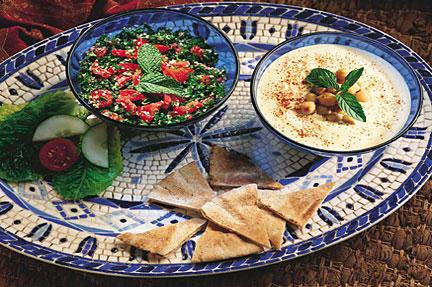
Continuity and Adaptation in Arab American Foodways by Lockwood & Lockwood (2000)
Summary and Reflection: This article details the presence, nature, and evolutionary identity of Arab food brought by Arab immigrants to urban Detroit. While the authors, Lockwood and Lockwood (2000), begin their work with a comparison on becoming ethnic a parallel to becoming a new subculture (p. 515), their main focus becomes about the diffusion of Arab food and foodways (how food is associated, used, presented, prepared, shared, taught, etc.) in Detroit in the Arab diaspora.
One of the strongest points made early on is that in any immigration story, one cannot make blanket generalizations about a sending country's population based on the receiving country's immigrant intake. For example, immigrants are always being drawn more heavily from certain regions within a country, from certain socio-economic conditions, religious groups, etc. (p. 515). Clearly, this can be better understood when considering our own nation—as diverse as we are from the Midwest to the South, the East Coast and West Coast, not to mention the diversity even within those regions. So it is when immigrants arrive here now, whether they are low-income Mexican laborers, persecuted Hmong, or asylum-seeking Somalis.
Such immigrant "pre-screening" has repercussions on the receiving country's perceptions of the immigrant group and their country of origin as well. Speaking specifically to food, as this article does, I can't help but think of Italian cuisine...that is, Italian cuisine as it is popularly understood in the U.S. (and again, more specifically, within my socio-economic bracket and in a Midwestern state). Naturally, the most common elements of Italian cuisine for me are spaghetti with tomato and meat sauce, pizza, lasagna, chicken parmesan, etc. Heavy on the melty white cheese, rich tomato sauch, meatballs and pasta. Of course, once I actually went to Italy and traveled to the various regions of that very diverse (albeit small) country, I was amazed as my Italian food paradigm was smashed to smithereens---and I mean that in a good way. Italian food—the "real" kind—is as delicious as it is diverse. And even though I found places that were purportedly "authentic", none of the versions of pizza, spaghetti bolognese (the tomato meat sauce we know), or lasagna that I sampled tasted like "home". Whether in flavor, texture, serving style, or ingredients, the details had invariably changed even in these Italian American standards.
The Lockwood & Lockwood focuses on these phenomena related to Arab American food in Detroit, examining how Arab food culture was first introduced and eventually diffused throughout the city, and how new waves of Arab immigrants are contributing to the ongoing story of Arab American food. Not surprisingly, the Italian example highlights similarities and potential future outcomes for the Arab Americans. First off, within the Arab community (spanning several countries, not just one), the Lebanese have emerged as the front runner in restaurant and grocery culture, thanks in part to having maintained a similar food commerce culture back home. This isn't true for all Arab countries. Now in the US, many non-Lebanese Arabs shop in the Lebanese markets as it is the best way to access the items and ingredients they need. Simultaneously, Lebanese markets are now carrying many traditionally non-Lebanese food items to cater to the demands of the customers.
Such "blending" is also occurring on restaurant menus, where items like "hummus" and "Greek salad" are becoming ubiquitous. And while to a culturally aware Arab, the nuanced flavors of the hummus can reveal themselves to be truly Lebanese versus truly Palestinian, the greater effect is that to the uninitiated or outsider perspective, such Lebanese (or insert other name) restaurants and markets present an image or idea about what Lebanese food is, and this notion/understanding is fed to the American market, thus slowly but surely reshaping its identity.
Food Sharing
In class this week we were all invited to bring in a food item to share as we discussed the article (but mostly focused on our own ideas related to culture, globalization, and food). I brought in Tajín, a Mexican seasoning you sprinkle on top of cut fruits or vegetables, like oranges, mangoes, and jicama. Some of the students had already tried Tajín and were familiar with it.
Questions & Thoughts:It was definitely great bringing in the different food items...I most appreciated Muhammad's grandmother's injera bread (delicious and different), but how fascinating the way people just "perk up" around food in general. As we went around the room, each of us really enjoyed talking and sharing about our food contributions and often had stories and reasons attached to why some particular food item was significant. Clearly, the emotional connections are strong---maybe as strong as the biological connections. These are important things I'm considering as I work on my semester project, which of course also deals with food--and foodways.
Monday, March 31, 2008
Week No. 10 of 16
Guest Speaker: Samaneh Vahaji
Summary & Reflections: This week in class Samaneh Vahaji, a 23-year old Iranian woman who is an undergraduate student in architecture at the UofM, came to talk to us about veiled women, including housing considerations, and her own personal experience as a veiled woman living in the United States. She began her talk with a Powerpoint presentation, explaining the religious motivations of muslim women to cover themselves in the presence of non-relative males. She also mentioned the poetry of a famous Iranian poet who wrote a verse explaining the reasons for women wearing the veil in terms of metaphors of men as water and women as fire. When there is no screen between the two, water dominates fire by extinguishing it. But if you add a screen between the two, like a clay pot for example, the fire will eventually heat the water, and even cause it to evaporate eventually. She used this example to counter some commonly held misconceptions on the part of westerners who view veiled women as oppressed.
At first Samaneh seemed quite nervous talking to us—this is understandable, since giving a talk in front of a room of strangers is always stressful. But I really admired her confidence to stand before us and speak frankly about her religious beliefs and convictions in a very open way. Sure enough, within a few minutes, and especially once she sat down and joined in our circle discussion, she seemed very relaxed, and the entire class was interested to hear more. It was noteworthy, I think, that the majority of our questions dealt with non-specifically design questions...It seemed we were all very eager to first understand her as a person...how did she handle day to day things? How did she date the man she eventually married? What does she look like under the veil? The kinds of questions that we were asking I think was particularly revealing of our own lack of interaction with veiled women, and probably with muslims in general. We know so very little about her life, beliefs, and day to day....it was more important to answer some of those basic human questions first.
Questions: I was surprised myself to be so fascinated by Samaneh. As she spoke I felt the veil having the opposite from intended effect on me! I grew so curious about her, what could she look like under that veil?! What does she think about the way we dress? I was glad when someone asked that question that I also wanted to hear the answer to. She was a great visitor to our class in the sense that she brought the real issues of "similarity" and "difference" right into our circle of desks. The difference was before our eyes. The similarity had to be coaxed out by our eager curiosity. Eventually, it was.
Hmong American New Year's dress: The display of ethnicity, by Annette Lynch (1995)
Summary & Reflections: This article by DHA alum Lynch talked about the ways in which displaced Hmong refugees living in the United States are maintaining ties to their Laotian culture while blending in elements of the new culture in the United States. Lynch talks about some differences across generations, but focuses her attention on the young people and traditional dress, which comes out mainly at Hmong New Year. What is interesting, is that as we pointed out in discussion, it's not always easy to tell a Hmong on the street, since their everyday dress may look completely "normal" to us---unlike a very easily distinguished veiled woman like Sameneh. But for the New Year's celebration, the Hmong bring out their traditional clothing with its painstaking handiwork...What is interesting, as Lynch points out, is how this "traditional" handcrafted clothing has changed in America. Now, the borders between Hmong clans are blurred (the totemic boundaries), but the ethnic boundary is stronger, as disparate Hmong subgroups have found solidarity in their Hmongness against dominant White American society. What they are facing culturally, politically, socially, and geographically is now being reflected in New Year's costume. Examples given included the blending of White and Green Hmong dress styles---something that never happened back in Laos, but is now commonplace in the U.S. Other cited examples showed complete breaks with Laotian customs, and new breakthroughs made possible by wealth, materials, and techniques acquired only since arriving in the U.S.
Questions: None, really. This was a well-written article that raised great points and highlighted some important ways in which dress is reflecting a shifting cultural identity under stress of transition. I do wish that more photographs had been included along with her written descriptions of White and Green styles. I'm not sure what else to comment on, the article was straightforward, and our discussion was somewhat brief.
Summary & Reflections: This week in class Samaneh Vahaji, a 23-year old Iranian woman who is an undergraduate student in architecture at the UofM, came to talk to us about veiled women, including housing considerations, and her own personal experience as a veiled woman living in the United States. She began her talk with a Powerpoint presentation, explaining the religious motivations of muslim women to cover themselves in the presence of non-relative males. She also mentioned the poetry of a famous Iranian poet who wrote a verse explaining the reasons for women wearing the veil in terms of metaphors of men as water and women as fire. When there is no screen between the two, water dominates fire by extinguishing it. But if you add a screen between the two, like a clay pot for example, the fire will eventually heat the water, and even cause it to evaporate eventually. She used this example to counter some commonly held misconceptions on the part of westerners who view veiled women as oppressed.
At first Samaneh seemed quite nervous talking to us—this is understandable, since giving a talk in front of a room of strangers is always stressful. But I really admired her confidence to stand before us and speak frankly about her religious beliefs and convictions in a very open way. Sure enough, within a few minutes, and especially once she sat down and joined in our circle discussion, she seemed very relaxed, and the entire class was interested to hear more. It was noteworthy, I think, that the majority of our questions dealt with non-specifically design questions...It seemed we were all very eager to first understand her as a person...how did she handle day to day things? How did she date the man she eventually married? What does she look like under the veil? The kinds of questions that we were asking I think was particularly revealing of our own lack of interaction with veiled women, and probably with muslims in general. We know so very little about her life, beliefs, and day to day....it was more important to answer some of those basic human questions first.
Questions: I was surprised myself to be so fascinated by Samaneh. As she spoke I felt the veil having the opposite from intended effect on me! I grew so curious about her, what could she look like under that veil?! What does she think about the way we dress? I was glad when someone asked that question that I also wanted to hear the answer to. She was a great visitor to our class in the sense that she brought the real issues of "similarity" and "difference" right into our circle of desks. The difference was before our eyes. The similarity had to be coaxed out by our eager curiosity. Eventually, it was.
Hmong American New Year's dress: The display of ethnicity, by Annette Lynch (1995)
Summary & Reflections: This article by DHA alum Lynch talked about the ways in which displaced Hmong refugees living in the United States are maintaining ties to their Laotian culture while blending in elements of the new culture in the United States. Lynch talks about some differences across generations, but focuses her attention on the young people and traditional dress, which comes out mainly at Hmong New Year. What is interesting, is that as we pointed out in discussion, it's not always easy to tell a Hmong on the street, since their everyday dress may look completely "normal" to us---unlike a very easily distinguished veiled woman like Sameneh. But for the New Year's celebration, the Hmong bring out their traditional clothing with its painstaking handiwork...What is interesting, as Lynch points out, is how this "traditional" handcrafted clothing has changed in America. Now, the borders between Hmong clans are blurred (the totemic boundaries), but the ethnic boundary is stronger, as disparate Hmong subgroups have found solidarity in their Hmongness against dominant White American society. What they are facing culturally, politically, socially, and geographically is now being reflected in New Year's costume. Examples given included the blending of White and Green Hmong dress styles---something that never happened back in Laos, but is now commonplace in the U.S. Other cited examples showed complete breaks with Laotian customs, and new breakthroughs made possible by wealth, materials, and techniques acquired only since arriving in the U.S.
Questions: None, really. This was a well-written article that raised great points and highlighted some important ways in which dress is reflecting a shifting cultural identity under stress of transition. I do wish that more photographs had been included along with her written descriptions of White and Green styles. I'm not sure what else to comment on, the article was straightforward, and our discussion was somewhat brief.
Wednesday, March 19, 2008
Week No. 8 of 16
 Jump Ahead: April 19th Class Trip to Pangea Theater's D'Lo show
Summary & Reflections: The show, presented at Intermedia Arts, was a one-woman montage of monologues interspersed with video bits featuring herself and her family, dealing with the life experiences of a young woman growing up gay and loving hip-hop in an immigrant Sri Lankan, Hindu family.
Talent wise, there's nothing really more to say. D'Lo was wonderful--very entertaining, very adept at taking on each of the multiple characters she assumed, both in costume and in persona. And she was extraordinarily convincing in this aspect—at first i didn't even know it was the same person when the mother came onstage! D'Lo's humor also helped keep the show's pace moving forward, as well as lighten the load of some of the heavier topics covered—like violence, homosexuality and discrimination, etc.
I especially appreciated what D'Lo was able to achieve as an artist in terms of utilizing such a s small stage and so few props. It was amazing the way she can captivate an audience on those terms and engage their interest as equally as if we were watching a Hollywood movie on a large theater screen. The immediacy and the life-quality of the theater as she used it was awesome.
Questions: It was a bit challenging for me to come and see this show, I can't lie. I wasn't that thrilled with it, not knowing what issues would be dealt with, and feeling like with all the amazing shows dealing with globalization, why this one? I was happy that real themes related to immigration and identity came through so strongly in the production. And I respect D'Lo's courage in facing her identity and embracing it despite the costs. It is, like I said, challenging for me, because it's not the framework I was raised in. Until my college years, I never really confronted anything dealing with transgenderism, so let's chalk it up to my culture as well. Still, after thinking about this for some time, I believe it is possible for our 2 views to coexist. I can respect her as an artist, as an individual, and as a human being, and we definitely come together in believing that to discriminate against someone for who they are is simply wrong. I ask the same respect of others, I have to offer that in return. It's a matter of not getting caught up in feeling that we all need to be the same--in this case, regarding our gender, dress, and sexual identities. Obviously we don't have to and we can't be!
Subscribe to:
Posts (Atom)